Amazon Video Ads: Sponsored Formats That Work in 2026
Four Amazon video placements do the actual work: Sponsored Brands, Sponsored Products, Sponsored Display, and the free main image video slot on the product page. Each one has its own spec, its own rules, and its own reason a creative gets rejected. This is the map, the numbers, and the AI shortcut for making the video itself in minutes instead of days.
 Daria BazankovaPublished 10 Sep 20269 min read
Key takeaways
- Amazon runs sponsored video in three ad products (Sponsored Brands, Sponsored Products, Sponsored Display) plus one free slot (main image video on the product page). Everything else is a niche placement most sellers do not need to think about.
- Amazon's own numbers on Sponsored Products Video: +67% CTR and +9% CVR versus non-video Sponsored Products ads. Shoppers who watch five seconds are 2× more likely to buy within seven days.
- Sponsored Products Video is the biggest open opportunity right now. It launched in late 2025, most sellers still have not shipped one, and the reason is simple: producing a compliant 16:9 no-audio product video used to cost a shoot. It does not anymore.
- Around 78% of plays are muted on mobile. Captions and on-screen text carry the message. Audio is optional on every sponsored format, and Sponsored Products Video bans it outright.
Amazon shoppers already have their card out. They come with intent, which is why a short product video in the search results earns clicks that the same still image does not. The click-through gap between video and static Sponsored Products is 67% by Amazon's own numbers, and the conversion gap is 9%.
The catch is that “Amazon video ads” is not one format. Four sponsored placements do the real work, and a file that ships to one will get rejected by another. This piece maps the four, gives you the numbers, and shows how a single product photo becomes an Amazon-ready video with AI, so the creative bottleneck stops being the reason you keep running image ads only.
The rest of the piece runs in this order: the four placements, the data behind them, a first-six-seconds playbook by category, the content rules that trip up sellers, and a three-step AI production flow.
1. The four Amazon video placements worth your time
Every Amazon video placement has a different job. Here they are, top to bottom, in the order most sellers meet them:
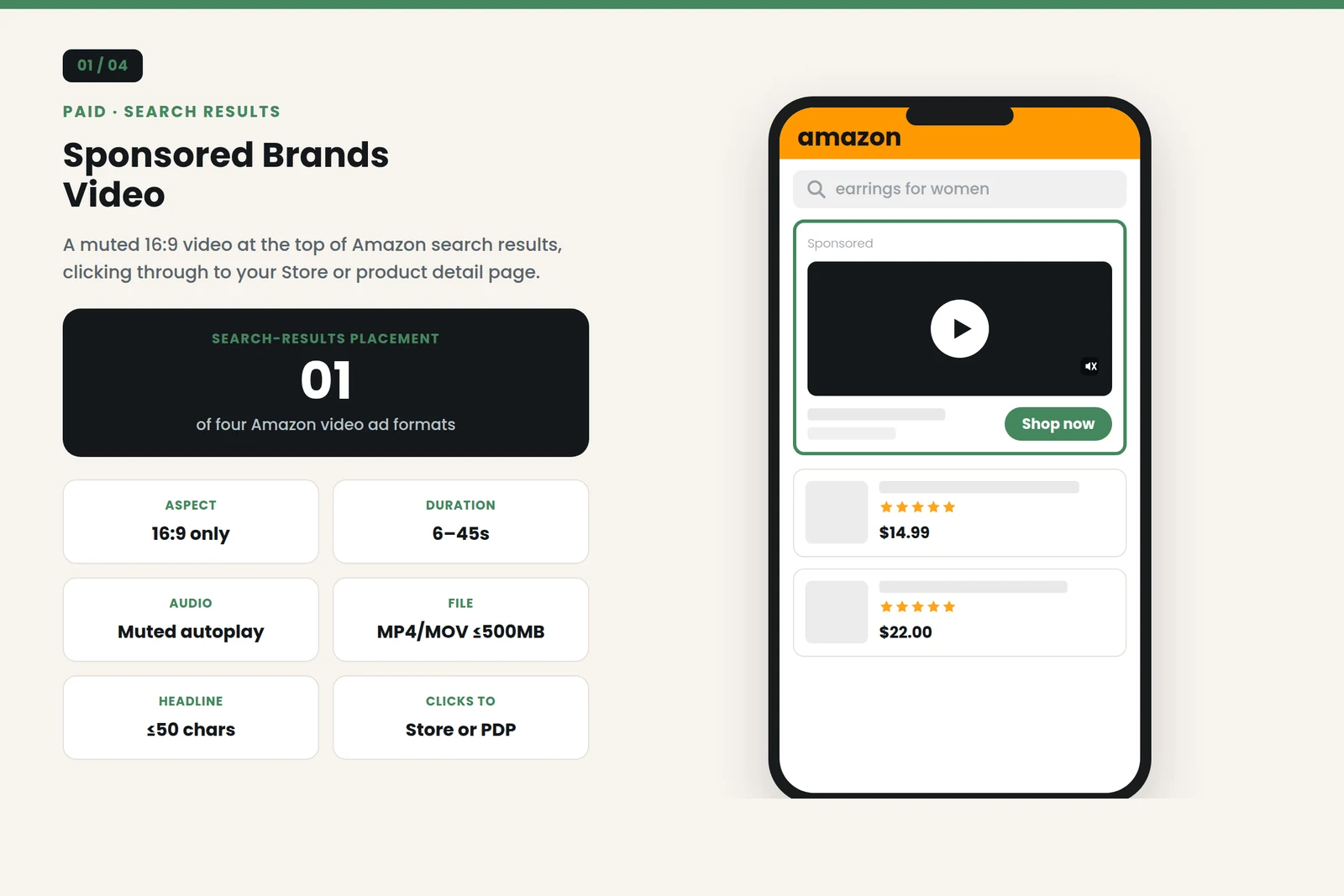
Sponsored Brands Video. Sits inside search results. Drives to your Store or product page. Best for brand-level campaigns.
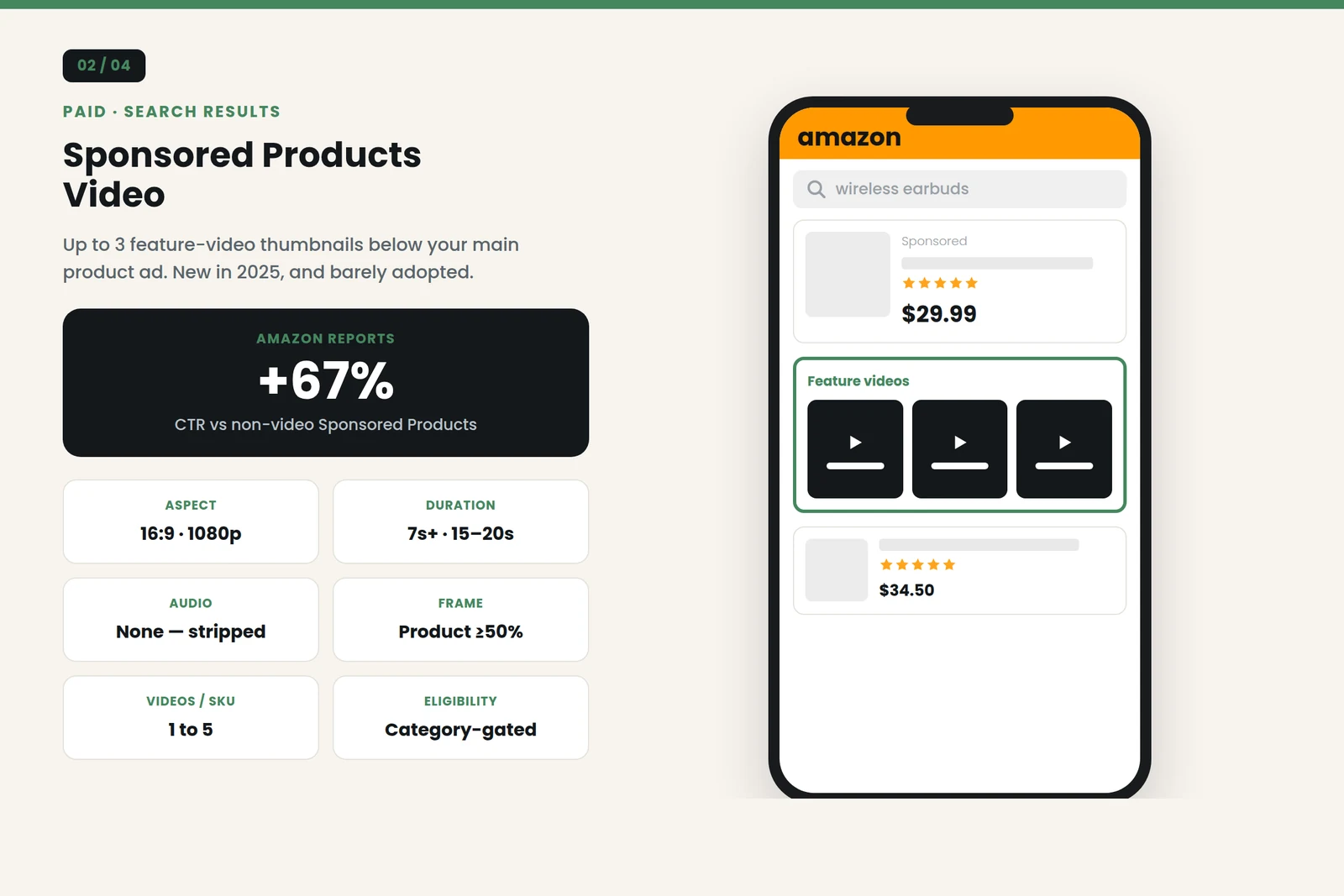
Sponsored Products Video. Also sits in search results, but attached to individual ASINs, not brands. The new format with the biggest performance gap over image ads and almost no seller adoption yet.
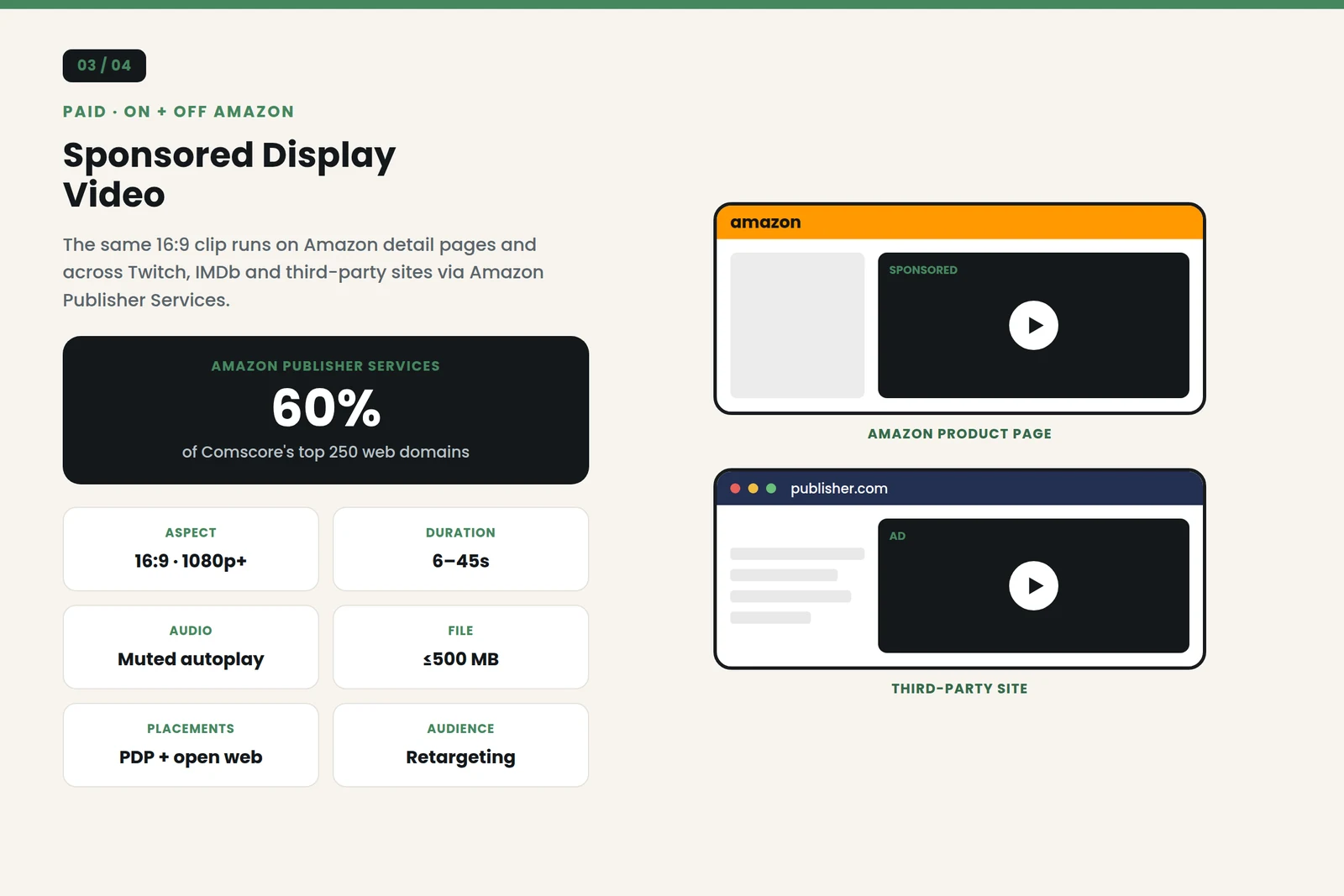
Sponsored Display Video. Runs on Amazon and off it, from the homepage to Twitch, IMDb, and around 60% of the top 250 sites on the open web through Amazon's Publisher Services.
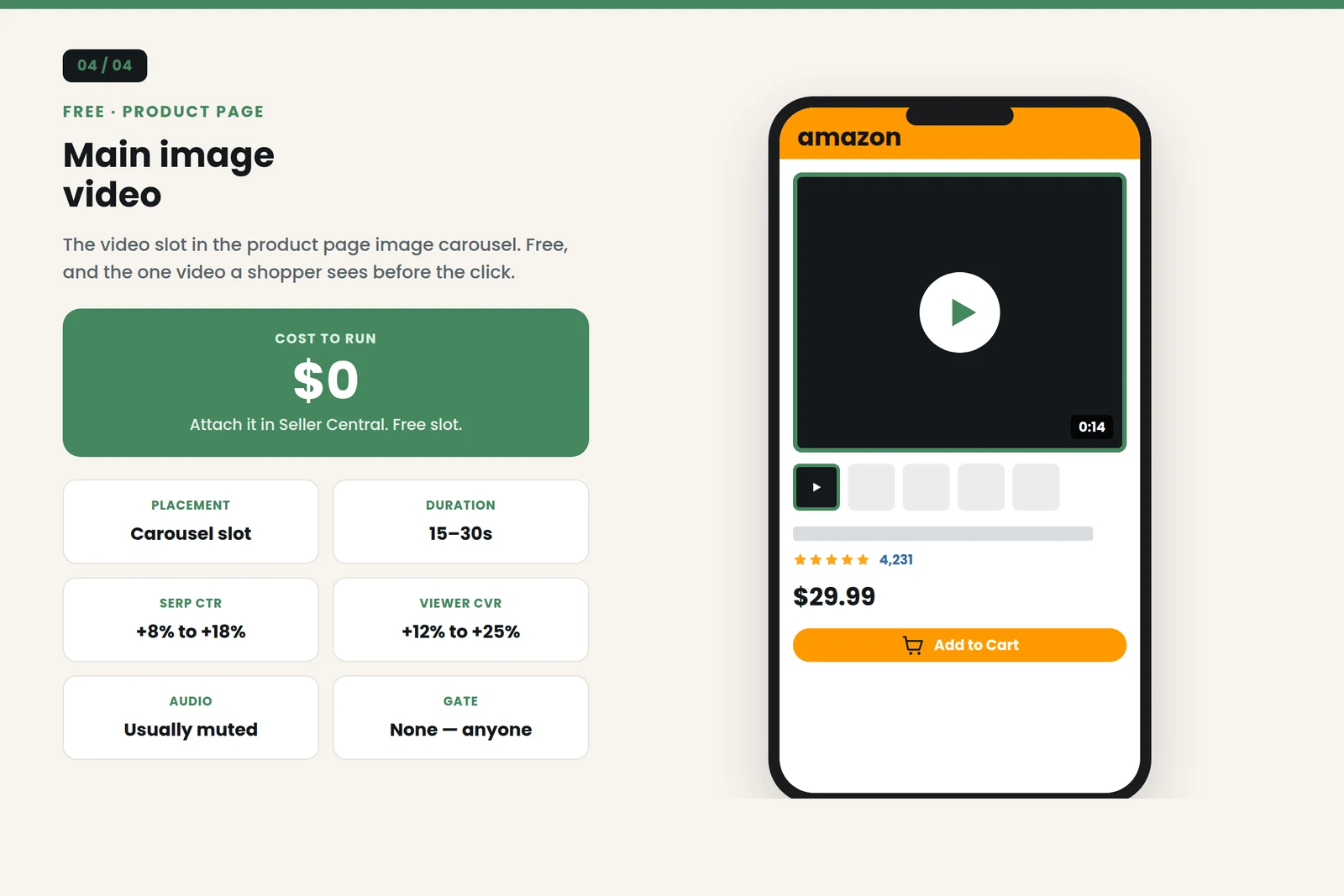
Main image video. The free slot in the product page carousel. Not a paid ad, but the one video a shopper sees before the click, and most sellers still leave it empty.
The one rule they share: 16:9. The one habit they share: autoplay muted. Get those two wrong and the file fails before any content review.
2. Sponsored Brands Video
Sponsored Brands Video is the format most people mean when they search “amazon sponsored video ads.” It plays inside search results, muted, and clicks through to a Store or a product detail page.
The spec:
- Duration: 6 to 45 seconds. Amazon recommends 20 seconds or less.
- Resolution: 720p, 1080p, or 4K
- Aspect ratio: 16:9 only
- File: MP4 or MOV, up to 500 MB
- Video codec: H.264 or H.265, 23.976–30 fps, minimum 1 Mbps
- Audio: PCM, AAC or MP3, minimum 96 kbps
- Headline: up to 50 characters
- CTA: pick one from Amazon's list (Shop now, Learn more, See details, etc.)
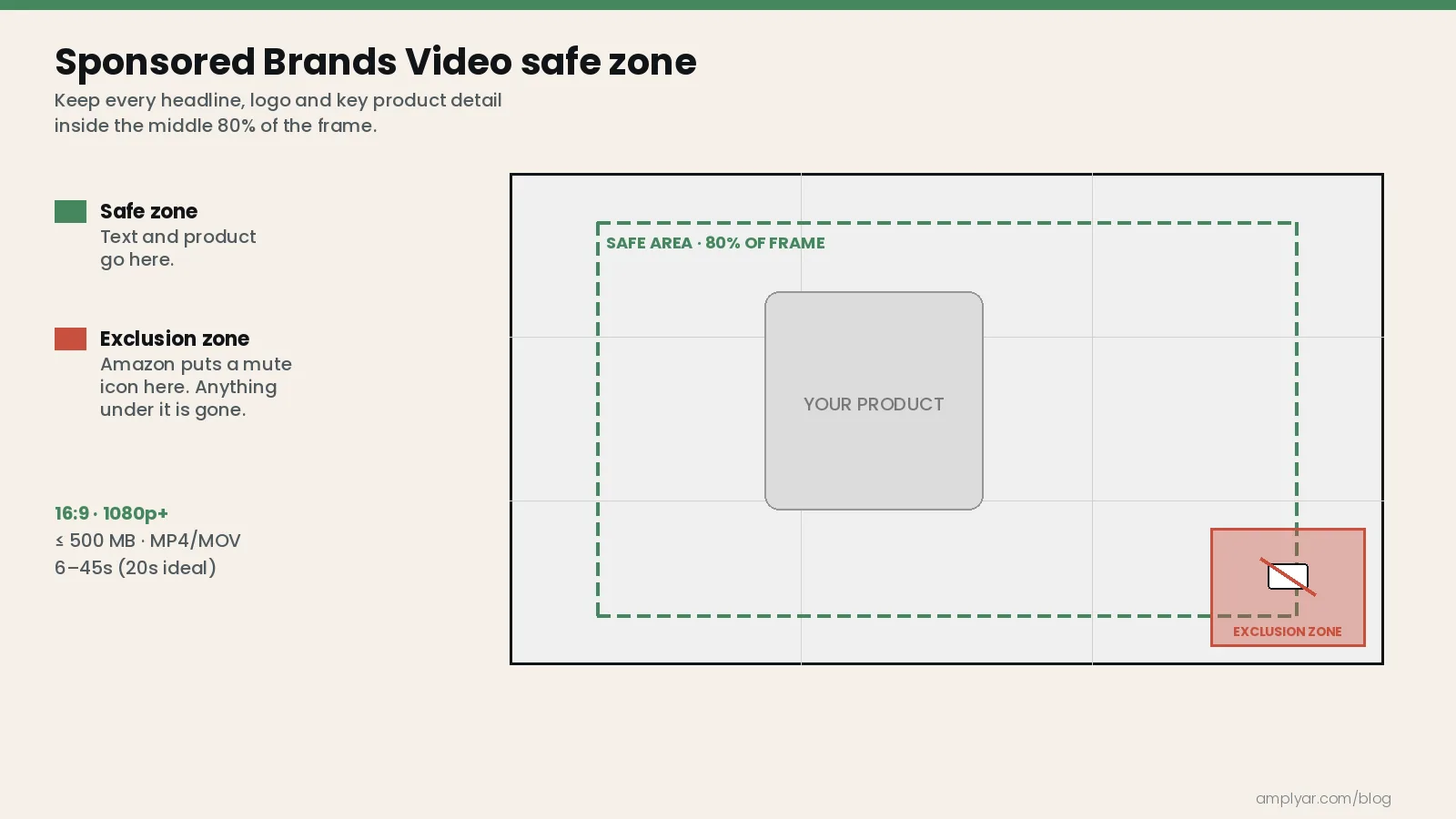
The one geometry rule that costs sellers a reshoot is the safe zone. Amazon overlays a mute-toggle button in the lower-right corner of every Sponsored Brands Video placement. Anything under that button is gone. Keep every headline, logo and product mark in the middle 80% of the frame with extra clearance on the right edge.
3. Sponsored Products Video
Sponsored Products Video launched at Amazon unBoxed 2025 and is expanding through 2026. It is not a new placement so much as an add-on to your existing Sponsored Products ad groups: you upload 1–5 feature videos per product, and shoppers see up to three thumbnails below the main product ad in search results.
The numbers Amazon publishes on it are the strongest video numbers on the platform: +67% CTR, +9% CVR, 2× purchase likelihood after a 5-second watch, 8× CTR among the top 20% of viewers who stay past that mark.
Here is the interesting part: most sellers still have not shipped one. Not because the format is hard to run, but because producing a compliant clip used to cost a shoot. The spec is unforgiving:
- Duration: minimum 7 seconds. Best performance at 15–20 seconds.
- Resolution: 1920×1080, 16:9 exactly
- File: MP4 or MOV, ≤ 500 MB
- Audio: none. It must be stripped before upload.
- Product must fill at least 50% of the frame.
- Filename:
ASIN 0000001, Product-in-use.mp4format required. - Product Feature Title: max 15 characters (3 words).
- Description: max 55 characters (6 words).
- Banned in the clip itself: burnt-in text overlays, persistent logos, slideshow effects, AI video generated by Amazon's own Creator Studio, “overly animated” motion.
Traditional production kills this format. You cannot cheaply shoot a series of 15-second product-in-use clips at the exact half-frame framing, in 16:9, silent, with strict filenames, one variant per feature. AI production does exactly that. One product photo becomes a 15-second 16:9 no-audio clip in minutes. The seller who ships five feature videos per SKU while the competition is still costing out a shoot is the seller who takes that +67% CTR gap.
Ship a compliant Sponsored Products video in minutes →
4. Sponsored Display Video
Sponsored Display Video runs the same 16:9 creative you already made for Sponsored Brands across a much wider surface: Amazon's homepage and product pages, Twitch, IMDb, and third-party sites and apps through Amazon Publisher Services. It is the retargeting formula for anyone who has already viewed your product.
Same core spec as Sponsored Brands:
- Duration: 6 to 45 seconds
- Resolution: 1920×1080 minimum
- Aspect ratio: 16:9
- File: ≤ 500 MB, H.264 / MPEG-2 / MPEG-4
- Frame rate: 23.976 to 29.97 fps
- Muted autoplay: yes
Two extra habits Amazon flags for this format specifically: keep the header and logo in the frame for brand recall, and add captions, because muted autoplay on mobile is the norm. Avoid black frames, blurry visuals and jarring cuts, which Amazon's own moderation flags more strictly on this network.
5. Main image video
The main image video is not a paid ad. It is the video you can attach to slots 2–9 of the product image carousel and, in some categories, as the primary image tested in search. It is free, and it is visible to shoppers before the click, which is more than any paid placement can say.
The performance data (Velocity Sellers' 2026 client benchmarks, agency data, not Amazon-official):
- Search-results CTR lift: +8% to +18%
- Unit-session CVR among viewers who actually watched: +12% to +25% versus non-viewers
If you are only going to ship one Amazon video for a SKU this quarter, ship this one. It costs nothing to run, it works on every category regardless of Sponsored Products Video eligibility, and the same 16:9 asset you produced for Sponsored Brands will drop straight in.
6. What the numbers say about video on Amazon
| Format | Metric | Source |
|---|---|---|
| Sponsored Products Video vs. non-video | +67% CTR, +9% CVR | Amazon, unBoxed 2025 |
| Sponsored Products Video (5-sec watchers) | 2× purchase within 7 days | Amazon |
| Sponsored Brands Video vs. static (Q4 2020) | +29% CVR | Tinuiti / MarketingCharts |
| Luxury electronics brand SB Video CVR | 3.52% vs 2.89% (+21%), −44% ACoS | PPC Hero case study |
| Main image video, SERP CTR lift | +8% to +18% | Velocity Sellers (2026) |
| Main image video, viewer CVR uplift | +12% to +25% | Velocity Sellers (2026) |
One case study worth naming in full: Macally, an electronics-accessories brand OMG Commerce ran video-inclusive ads for. Ad spend scaled from around $2.5–3K per month at 22–24% ACoS to $13.3K per month at 19.9% ACoS over four months. Lifetime run: $83,365 in spend, $416,743 in sales, 20% ACoS. The tactic that made the difference: they refreshed creative continuously instead of running one video indefinitely, and they raised budget once video proved efficient. The reflex most sellers have with a new format is the opposite.
Honest caveat: the +67% / +9% headline comes from Amazon's own reporting on a format Amazon is actively selling. Directionally consistent with every earlier study, but frame it as “Amazon reports” rather than an audited benchmark.
7. What to show in the first six seconds
Amazon's own guidance for Sponsored Brands Video is short:
- Introduce the product or its function in the first 5 seconds
- Inspire and educate through the middle of the clip
- Call to action to close
Add three practical rules on top: put the strongest visual in the 4–8 second window (Amazon's own peak-engagement data), never open or close on a black frame, and close the loop cleanly because the ad auto-repeats.
Category playbook, in short:
- Jewelry and accessories: macro close-ups of facets, prongs, links and finish. Real light on real metal, not post-production sparkle. Warm or neutral lighting on silver and white gold — cool blue reads as gray. 5-second reveal for a hero SKU, 10–15 seconds for a multi-angle proof cut, 30 seconds only if there is a real gifting story.
- Apparel and footwear: show fit, drape, stretch in motion. Brief cuts across a couple of body types build trust and reduce returns.
- Electronics: motion graphics and animated feature callouts on top of live-action demo beat lifestyle-only storytelling. The category most agencies rank highest for video ROI.
- Home, beauty, outdoor, sports: high priority for video. Product-in-use is the whole point.
- Grocery and sub-$15 accessories: low priority. Video rarely pays back at those unit economics.
8. What Amazon will reject
Amazon's own moderation guide for Sponsored Brands and Sponsored Display lists this cleanly.
Prohibited inside the video itself:
- Customer reviews or star ratings, even if sourced from Amazon
- Amazon's own branding, trademarks, or product references
- Discounts, savings call-outs, or specific pricing
- Flashing, spinning, blinking or pulsating visual elements
- Superiority claims (“best”, “biggest”, “most”) without substantiation
- Fake or mocked-up clickable UI elements
- Sexually explicit content, e-cigarettes, prescription medications, profanity
- Ads for out-of-stock or unavailable products
Required:
- Product visible within the first 1–2 seconds
- Text large enough for a normal shopper to read
- No letterbox or pillarbox bars
- Primary language matches the marketplace
- Ad content accurately reflects the linked product detail page
- “Deal” language only allowed if an Amazon deal is running for the full campaign
- Holiday-specific campaigns must end within 24 hours of the event
Rejection triggers sellers underestimate:
- Typos or spelling errors
- More than two “?”, “!” or “…” in sequence
- Non-sentence-case capitalization
- Low resolution imagery (under 72 ppi)
- Cluttered or crowded composition
Submit creative at least a week before campaign launch. A rejection means at least one full resubmission cycle.
9. Making an Amazon-ready video ad with AI in three steps
The whole spec map above collapses to three decisions:
- Pick the photo. Use the same hero image that already sits on the product page. That way the video reads as continuous with the listing and passes the “content accurately reflects the linked product page” rule cleanly.
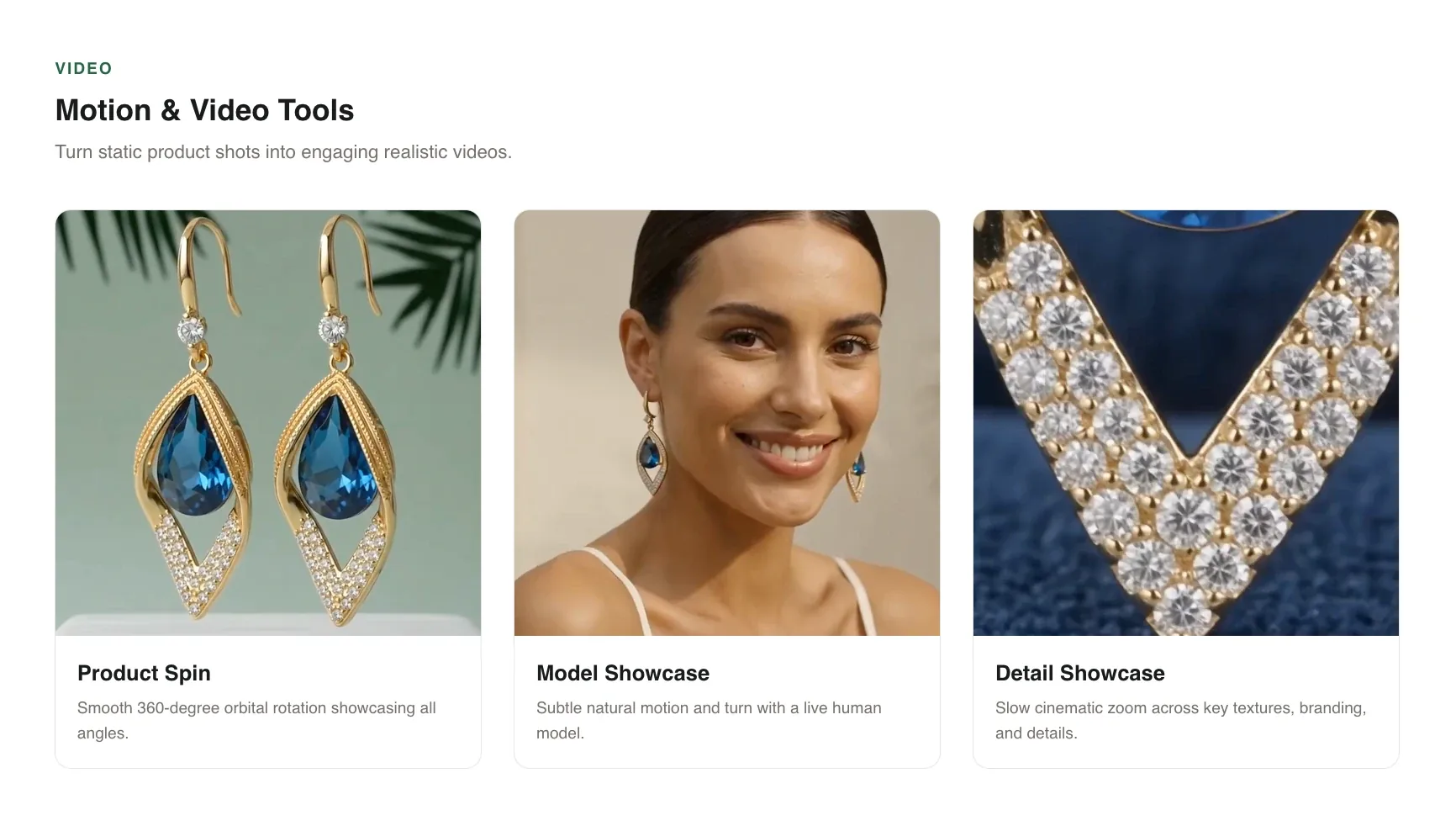
- Pick the template. Product spin for a 360-degree view, model showcase for anything worn (jewelry, apparel), detail showcase for craftsmanship stories (jewelry, electronics, textured products).
- Set duration and ratio to the placement. 15–20 seconds and 16:9 for Sponsored Products (strip the audio on export). 20 seconds or less and 16:9 for Sponsored Brands and Sponsored Display. Longer permitted, but shorter converts better.
The reason to route this through an AI workflow rather than a video studio is not just cost or speed, though both are large. It is that the spec is baked into the output. A file generated to Sponsored Brands or Sponsored Products settings clears the aspect ratio, the resolution, the file size, the 500 MB cap and the safe zone the first time. A variant for a second placement costs nothing to produce.
Frequently asked questions
Every paid Amazon video placement runs 16:9 at 1080p or higher, up to 500 MB, in MP4 or MOV. Sponsored Brands Video allows 6 to 45 seconds with 20 seconds or less recommended. Sponsored Products Video needs 7 seconds minimum with 15 to 20 seconds performing best. Muted autoplay is the default across every sponsored placement.
Yes for Sponsored Brands, Sponsored Display and the free main image video slot on your listing. Sponsored Products Video prohibits AI video from Amazon's own Creator Studio, but Amazon does not police AI video from other tools by origin. What it enforces is the moderation policy, which any well-produced AI video passes cleanly.
No. About 78 percent of plays happen with audio off on mobile, so captions and on-screen text carry the message. For Sponsored Products Video you are required to strip the audio entirely before upload. Sponsored Brands and Sponsored Display allow audio but should not depend on it.
Sponsored Products Video is category-gated and Amazon does not publish an eligibility list. An Amazon community manager confirmed on the Seller Forums that the option simply does not appear for ineligible categories. Open a case ticket for your category and run Sponsored Brands Video in the meantime, which is not gated.
Daria Bazankova
Writes about e-commerce imagery and AI at Amplyar.
Keep reading
Facebook jewelry ads that work in 2026
10 min read · 27 Aug 2026
Best AI for Jewelry Photography in 2026: Six Tools Compared
14 min read · 24 Aug 2026

AI Jewelry Photography Tutorial: One Phone Photo to Amazon, Shopify and Etsy Listings
8 min read · 19 Aug 2026