Quick Verdict
Feature Comparison
| Feature |  |  |
|---|---|---|
| AI product photos (studio backgrounds) | Yes | Yes |
| On-model / virtual try-on | Yes | Yes |
| Ghost mannequin | Yes | Yes |
| AI ad banners / creatives | Yes | Yes |
| Ad videos | Yes | Yes |
| Model Maker (custom AI models) | Yes | No |
| MCP access via Claude / ChatGPT | Yes | No |
| Background removal | Yes | Yes |
| Image upscaling | Yes | Yes |
| Watermark on free tier | Small corner mark (removed on any paid plan) | Tiled across the whole on-model frame on free (no crop removes it); removed on paid plans |
| Free credits | 7 (welcome) | 20 |
| Starting paid price (monthly) | $11/mo | $29/mo |
| Starting paid price (yearly) | $9/mo | $14.50/mo |
SellerPic Pricing Breakdown (2026)
SellerPic uses a credit-based system: every image or video costs a set number of credits, and credits refresh monthly. There's a free trial with 20 credits (no card required) and four paid tiers, billed monthly or yearly.
| Plan | Yearly (per month) | Monthly | Credits / month | Highlights |
|---|---|---|---|---|
| Free | $0 | $0 | 20 (one-off) | Trial access, no card |
| Starter | $14.50/mo | $29/mo | 200 | 5 scheduled posts/day, 3 concurrent videos |
| Growth | $39.50/mo | $79/mo | 600 | Same limits, higher volume |
| Advanced (Most Popular) | $49.50/mo | $99/mo | 3,000 | 10 posts/day, 5 videos, Pro Master Mode |
| Enterprise | Custom | Custom | Custom | API access, custom volume |
For context, Amplyar's paid plans start at $9/mo (Basic, yearly) with 100 credits, and go up to $79/mo (Scale, yearly) with 1,500 credits, see Amplyar pricing.
SellerPic Review 2026: The Complete Guide
Overview
SellerPic positions itself as an all-in-one AI photo suite for e-commerce sellers, especially Shopify merchants. Its core promise: replace a large chunk of your product-photography and creative-production stack with one dashboard, AI model swaps for apparel, virtual try-on, ghost mannequin, ad videos, background editing, and scheduled publishing to social channels. The workflow is chat-based: you upload a product image, describe what you want in natural language, and SellerPic renders it.
Key Features
- AI Model Swaps. Change the model wearing a product, generate new model photos in different poses, ethnicities and settings without a photoshoot.
- Virtual Try-On & Video. Try apparel and accessories on AI models, generate short product videos from a single image.
- Ghost Mannequin Removal. Automatic invisible-mannequin editing for apparel catalog shots.
- Shopify Sync. Direct integration with Shopify stores for pushing edited images back to product listings.
- Multi-Model Rendering Engine. SellerPic routes each request through several underlying image engines, so output style can vary across generations.
- Scheduled Posting. Built-in scheduler for pushing generated content to social channels (5–10 posts/day depending on plan).
How we tested it (jewelry brief)
We ran SellerPic on the same three use-cases we run on every tool in the benchmark: Studio product photo on a black background, Worn by a model, and Advertising banner for this product. Real vintage ring, free plan, minimal prompt.
Studio background, side-by-side
Same input ring, same prompt (Studio product photo on a black background), same day. Amplyar preserved the cabochon shape; SellerPic rebuilt it rounder and more faceted.
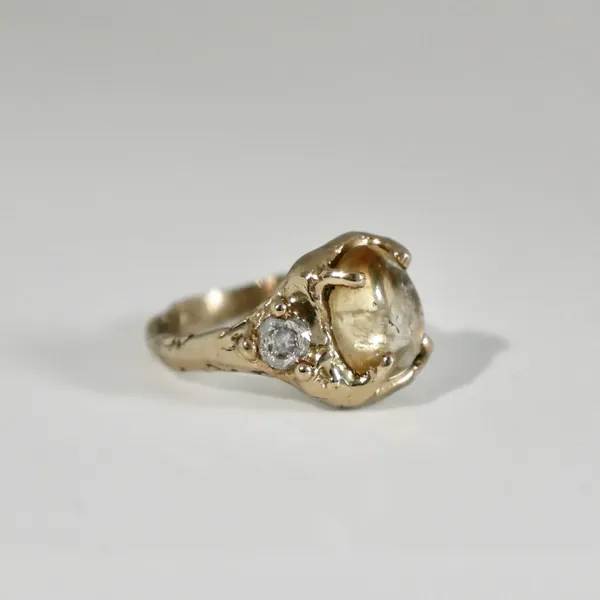
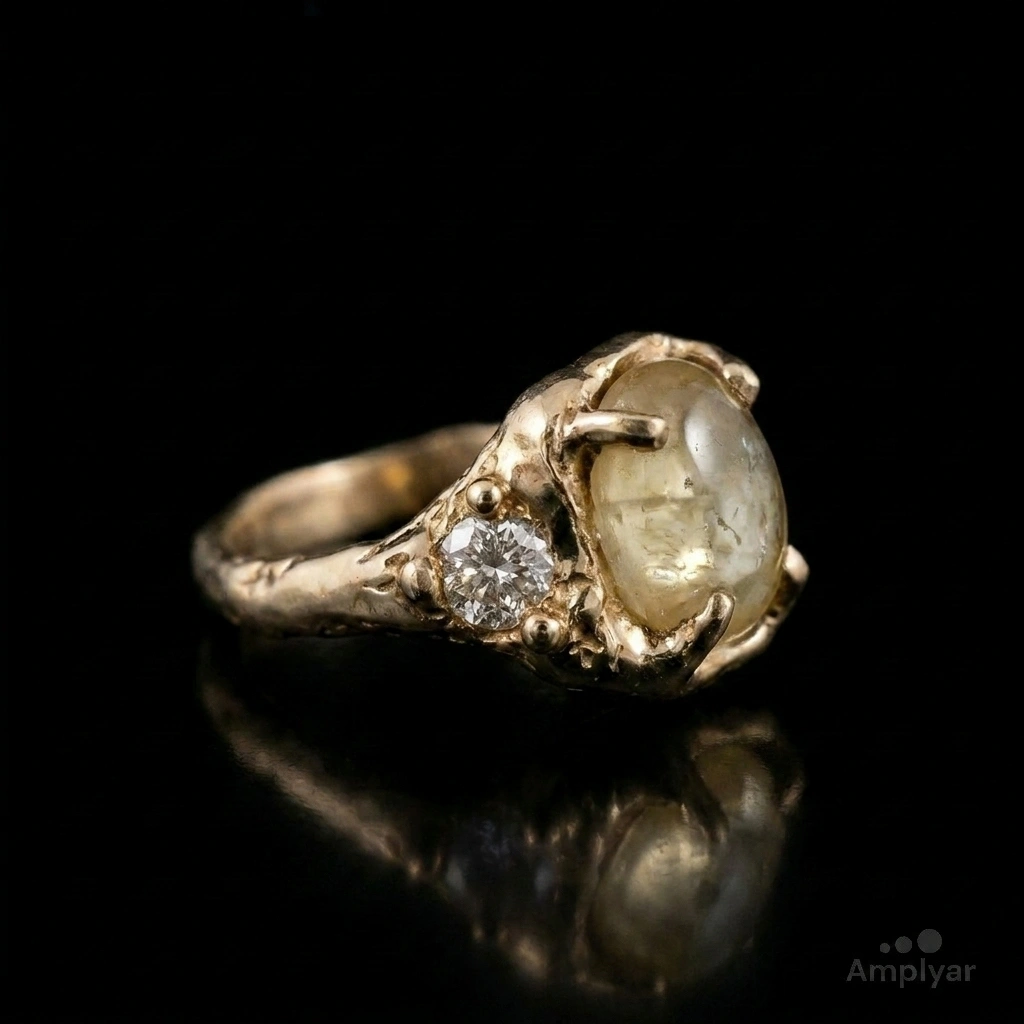
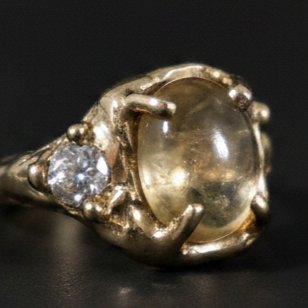
- Studio background, 12/15, ~8–10s, 1 credit (vs Amplyar's 15/15). Realistic top light, believable shadow, correct black field. Loses points because the cabochon comes back rounder and more faceted than the original, the stone is rebuilt rather than reproduced, and the side diamond grows with it. Attractive image, subtly different ring.
- On model, 13/15, 1 credit (vs Amplyar's 14/15). Correct hand anatomy, no invented extra jewellery, sensible framing with the hand filling the frame at 768×1344. Same stone-softening issue carries across from studio; light is plainer than the top result. Important: on the free tier the on-model frame is tiled with repeated SellerPic marks across the whole image, no crop removes them, so the picture is not publishable until you pay.
- Ad banner, coherent AI-generated headline and layout with the ring preserved. Worth noting: the AI invented a brand name and domain in the banner text, which is a general risk with any generative ad tool, always review before publishing.
Combined score: 25/30, second overall behind Amplyar (29/30). Full comparison: Best AI for Jewelry Photography in 2026.
Pros and Cons
Pros
- Broad feature set, models, try-on, ghost mannequin, ad videos in one dashboard
- Shopify sync for merchants
- Choice of underlying rendering models
- Correct hand anatomy in on-model output for jewelry (13/15 in our test)
- No card required for the 20-credit free trial
- Coherent AI text on generated ad banners
Cons
- Free trial is one-off (20 credits); no recurring free tier
- On-model frame on free tier is tiled with watermarks across the whole image, no crop removes them
- Rebuilds irregular stones into rounder, more faceted versions (cost fidelity points in both studio and on-model in our test)
- Higher entry price than most direct competitors ($29/mo starter vs $11 on Amplyar Basic)
- No custom Model Maker, you pick from what's provided
- No native MCP integration for Claude / ChatGPT
User Experience and Performance
SellerPic's chat-first UI is fast to learn: upload, type, generate. The credit balance is always visible in the sidebar. Generation time in our test was around 8–10 seconds per image. The dashboard groups features into workflows (AI Models, Try-On, Videos, Background), which is useful for teams processing multiple SKUs a day. Master Mode on the Advanced plan unlocks finer control over prompts and model selection.
Who is SellerPic For?
Great fit
- Shopify merchants with a large apparel or accessories catalog
- Sellers who need models + try-on + ad videos in one tool
- Teams comfortable at the $29–$99/mo range and running high volume
Less good fit
- Solo sellers and small brands on a tight budget (Basic plans on other tools start much lower)
- Jewelry, watches and small-object sellers who lean heavily on on-model shots
- Teams that want to drive generation from ChatGPT or Claude via MCP
- Anyone who needs a custom-trained model of their own product line
Amplyar vs SellerPic, the 2026 showdown
The short version: nearly identical feature sets, Amplyar is cheaper at entry and scored higher on the same jewelry test.
1. Pricing, Amplyar wins entry by a wide margin
| Plan | Amplyar (yearly) | SellerPic (yearly) | Amplyar advantage |
|---|---|---|---|
| Entry paid | $9/mo | $14.50/mo (Starter, 200 credits) | −38% at entry |
| Mid tier | $31/mo (Pro, 500 credits) | $39.50/mo (Growth, 600 credits) | −22% |
| Top tier | $79/mo (Scale, 1,500 credits) | $49.50/mo (Advanced, 3,000 credits) | SellerPic scales higher on volume |
Entry paid on Amplyar is the Basic plan with 100 credits. For a solo seller or small brand, Amplyar's $9 entry means a real paid workflow at the price of a coffee. SellerPic starts at a Shopify-store price point.
2. Features, near-parity, with two Amplyar-only capabilities
Studio backgrounds, on-model / virtual try-on, ghost mannequin, ad banners, ad videos, background removal, upscaling, both tools cover all of it. Where they diverge:
| | |
|---|---|---|
| Custom Model Maker (train a model of your product) | Yes | No |
| MCP access from Claude / ChatGPT | Yes | No |
| Shopify direct sync | No | Yes |
For most sellers the Amplyar-only features are the higher-value ones, a custom model of your actual product line, and the ability to generate from within your AI assistant workflow.
3. Quality, same ring, same prompts, Amplyar scored 4 points higher
Both tools were run on the same vintage ring, the same two prompts, the same free tier, with the same scoring rubric published in Best AI for Jewelry Photography in 2026:
| | |
|---|---|---|
| Studio (product accuracy · realism · brief) | 15/15, ~10s, 2 credits | 12/15, ~8–10s, 1 credit |
| On model (product accuracy · realism · brief) | 14/15, ~20s, 2 credits, 768×1376 | 13/15, 1 credit, 768×1344 |
| Combined | 29/30 | 25/30 |
| Free-tier watermark | Small corner mark | Tiled across on-model frame, not publishable until paid |
| Cost shown before spend | Yes, on the button | Balance visible in sidebar |
| Stone fidelity on a vintage cabochon | Preserved exactly | Rebuilt rounder / more faceted |
Final Verdict
SellerPic is a capable, e-commerce-tuned AI suite that earns its place in the market for Shopify-heavy apparel workflows. Its pricing is on the higher side, and its architecture leans on third-party foundation models rather than a proprietary engine. If those trade-offs fit your workflow, it's a solid tool.
Which Should You Choose?
Choose SellerPic if:
you sell apparel on Shopify, run high volume, and want models + try-on + ad videos in one dashboard.
Choose Amplyar if:
you want lower starting price, a Model Maker for a custom AI model of your product, and MCP access from Claude / ChatGPT.
Frequently Asked Questions
Ready to Get Started?
Related reviews
Claid AI review
Batchable product-photo editor. Great studio swaps, wide-frame try-on that misses on jewelry.
Photoroom review
Popular mobile-first background remover with AI backgrounds.
PicCopilot review
AI photo agent with templates and virtual try-on.
Tashvi review
AI fashion design and generative product imagery.
Amplyar vs SellerPic
Same ring, same prompts: 29/30 vs 25/30, and a 38% cheaper entry plan.